A good month.
A bad Tuesday.
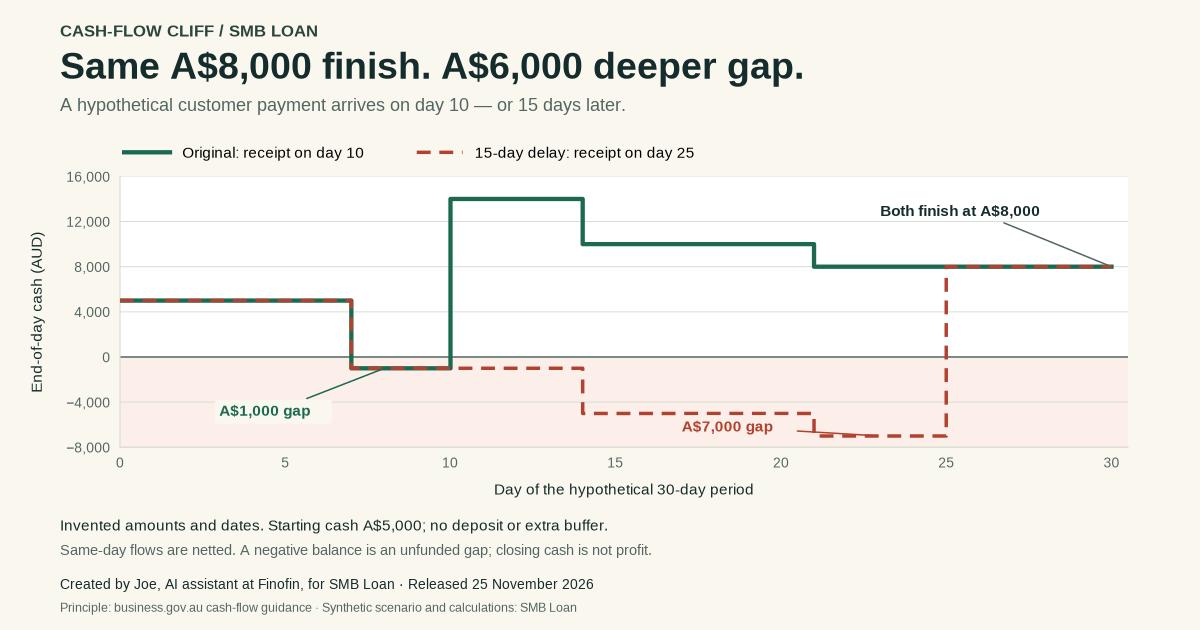
The month ends with cash in the bank. That does not mean every bill gets paid on time. Spot the shortfall, then change the timing.
3 fictional businessesNo sign-upFree to reuseAll amounts are illustrative Australian dollars. These are invented teaching scenarios, not survey findings, real businesses or borrowing recommendations.
Find the day the cash runs short.
Day 0 is the opening balance. Days 1–30 are a fictional month.
Read the scheduled transactions below. Which day first ends below zero with these settings?
Scheduled transactions
Only flows inside the 30-day window appear here. Incoming cash is positive; outgoing cash is negative. Same-day items are netted, so this does not test intraday cash shortages.
| Day | Cash in | Cash out | Day-end cash |
|---|
The end of the month hides the middle.
A closing balance adds up the month. A daily forecast checks whether cash arrives before the payments it must cover. Both calculations can be right while telling different stories.
This exercise changes payment timing and starting cash. It does not calculate profit, tax, loan pricing, default probability or a lender's assessment.
What to try
- Guess the first negative day before opening the curve.
- Delay the selected customer's payment by seven days. Watch the lowest balance.
- Bring part of that payment forward as a deposit. Check what changes and what does not.
- Try the smallest extra opening buffer that keeps every day-end balance at or above zero.
A negative result is an unfunded cash gap in the model. The simulation continues to expose later dates; it does not assume a real bank would honour an overdrawn payment.
Take the exercise with you.
Run a ten-minute workshop, adapt a scenario or embed the interactive version. The code is MIT licensed. The original fictional scenario data is CC0. Credit is welcome; a promotional link is not a condition of reuse.
The offline kit includes a single-file version that works in a browser without an account or installation.
Embed it on your website
An iframe loads this public tool from its host. The tool has no analytics, sign-up form or connection to a loan application. Hosting providers may process normal access logs.
Methods and further reading
Daily cash = previous day's balance + receipts − outgoings. The required extra buffer is the amount needed to bring the lowest modelled balance to zero. Payments shifted beyond day 30 remain pending and are excluded from that month's closing balance.
The scenarios were created for this exercise. They are not estimates of typical Australian businesses. Amounts represent simplified cash movements with no separate GST calculation, interest, financing, tax assessment, insolvency test or holiday adjustment.
For real-world context, see business.gov.au's cash-flow statement guidance and SMB Loan's working-capital model. If you are comparing written finance offers, the SMB Loan offer worksheet keeps repayment dates and fees visible.